Every November, America retells the same story: grateful Pilgrims, a long table, a prayer, a turkey. It’s a lovely story. It’s also a heavily edited one, and the edits are the interesting part. The people now credited with inventing America’s favourite feast day had strong opinions about holidays, and most of those opinions were “no”.
1. The people who gave us Thanksgiving banned Christmas
The Pilgrims of Plymouth didn’t celebrate Christmas, because it isn’t commanded in Scripture. On Christmas Day 1621, just weeks after the famous harvest feast, Governor William Bradford called the colony out to work as usual. Some newcomers said working that day “went against their consciences,” so he excused them. When he came back at noon and found them playing stool-ball in the street, he took away their equipment, telling them it was against his conscience that they should play while others worked. He recorded it himself in Of Plymouth Plantation, as a passage “rather of mirth than of weight”.
Their Puritan neighbours in Massachusetts Bay went further and put it in law. In 1659 the General Court ordered that “whosoever shall be found observing any such day as Christmas or the like, either by forbearing of labor, feasting, or any other way” would pay five shillings per offence (you can read the full text from the colony’s records). The ban was repealed in 1681 under pressure from London, and Christmas didn’t become a state holiday in Massachusetts until 1856. So the next time someone warns you about a “war on Christmas”, you can tell them who actually won one.
2. The “First Thanksgiving” wasn’t called a thanksgiving
The only eyewitness account of the 1621 feast is a few lines in a letter by Edward Winslow, published in Mourt’s Relation. He describes a harvest celebration, men out shooting fowl, and Massasoit arriving “with some 90 men”, who were “entertained and feasted” for three days and went out and killed five deer for it. Nobody at the time called it a thanksgiving. According to Plimoth Patuxet, the label stuck only in 1841, when a minister named Alexander Young added a footnote to the letter: “This was the first Thanksgiving.” A whole national myth, courtesy of a footnote.
3. A real Puritan thanksgiving was church, not dinner
To a 17th-century Puritan, a “day of thanksgiving” was a religious event, called whenever God seemed to have done something useful. As Plimoth Patuxet explains, these days were not held on a regular basis and generally meant church services and fasting. In 1623, a drought threatened the corn, so the colony held a day of “humiliation and prayer”. The rain came, so they held a day of thanksgiving. The Pilgrim Hall Museum puts it plainly: the 1621 event was “a secular harvest feast”. The holiday you’re eating today merges the two: the party survived, while the fasting and the sermon quietly lost the vote.
It’s also a neat demonstration of how prayer “works”. Pray during a drought and it rains eventually, because droughts end. Count the rain, forget the droughts that didn’t break, and you have a theology.
4. The first national Thanksgiving was today’s date, 237 years ago
In 1789, the first Congress asked President George Washington to recommend a day of thanksgiving, and he named Thursday, November 26, 1789. Later presidents issued proclamations too, but the dates and even the months moved around for decades.
5. Thomas Jefferson refused to do it
One president wouldn’t play along. Asked by a Presbyterian minister, the Rev. Samuel Miller, to recommend a national day of fasting and prayer, Jefferson replied in a letter dated January 23, 1808 that he considered the federal government “interdicted by the constitution from intermedling with religious institutions, their doctrines, discipline, or exercises.” Even a mere recommendation, he argued, would carry “some degree of proscription perhaps in public opinion” for those who ignored it. And: “fasting & prayer are religious exercises.” Civil powers alone, he wrote, had been given to the president, “and no authority to direct the religious exercises of his constituents.”
Read that again next time a politician says the founders wanted a Christian nation. One of the most famous founders thought even suggesting a prayer day was above his pay grade.
6. It took a magazine editor, a war and a shopping season to fix the date
The national holiday owes more to Sarah Josepha Hale than to any Pilgrim. Hale, editor of Godey’s Lady’s Book and the author of “Mary Had a Little Lamb”, spent years lobbying for a single national day. In a letter to Abraham Lincoln on September 28, 1863, she wrote that she had pushed the idea in her magazine “for the last fifteen years” and asked him to proclaim the last Thursday of November. He did, days later, on October 3.
Then, in 1939, the last Thursday fell on November 30. Worried that a short Christmas shopping season would hurt the recovery, Franklin D. Roosevelt moved Thanksgiving a week earlier. According to the National Archives, 32 states went along and 16 refused, so for two years America had two Thanksgivings. FDR admitted in 1941 that the experiment “did not work”, as recorded in the National Archives’ Prologue magazine, and on December 26, 1941 he signed the joint resolution fixing the holiday on the fourth Thursday of November, where it has stayed ever since.
So the date of America’s most “sacred” family holiday was finally set by Congress, mostly to keep the retailers happy. That may be the most American religious fact of all.
What’s left on the table
Strip out the edits and Thanksgiving turns out to be a harvest party that outlived the people who tried to make it a fast day, rescued by a magazine editor and scheduled for the shops. You don’t need to believe anyone is listening to be grateful for the people around the table. If your family dinner today came with a long grace you sat through politely, there’s a mug for that: Same Table. Fewer Prayers.
Did your family say grace at Thanksgiving, and do you still? Tell us on the Facebook page.
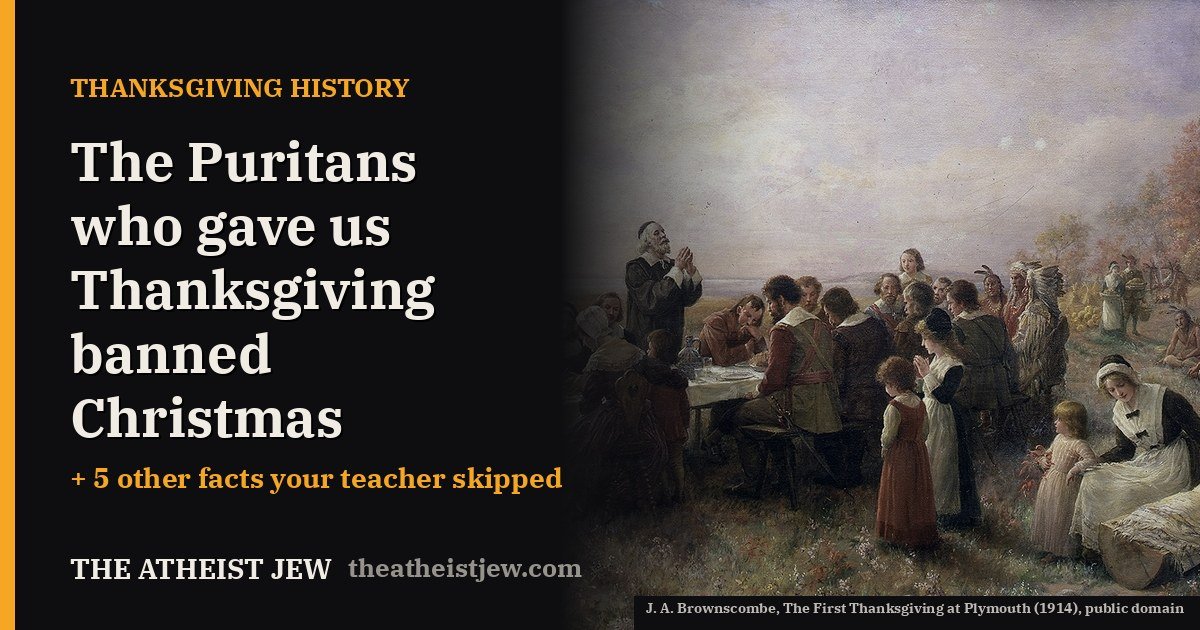
Image: Jennie Augusta Brownscombe, The First Thanksgiving at Plymouth (1914), public domain, via Wikimedia Commons.